
RICE for CRO: Which Shopify improvement comes first?
Ten improvements are waiting for your store. Marketing wants a landing page, service wants better sizing guidance and development wants to replace an unreliable feature. Each request has a reasonable explanation. There's still only enough time for some of them next month. If the loudest request usually wins, a shared basis for the decision can help. RICE is one possible approach.
For CRO, I would use RICE as a discussion tool. The result organizes assumptions but doesn't replace professional judgment. A number with two decimal places can look precise while its inputs are rough estimates. Keep the reasoning beside the score. Everyone should be able to see which idea has evidence, where information is missing and why a lower-scoring task may still come first.
What RICE compares
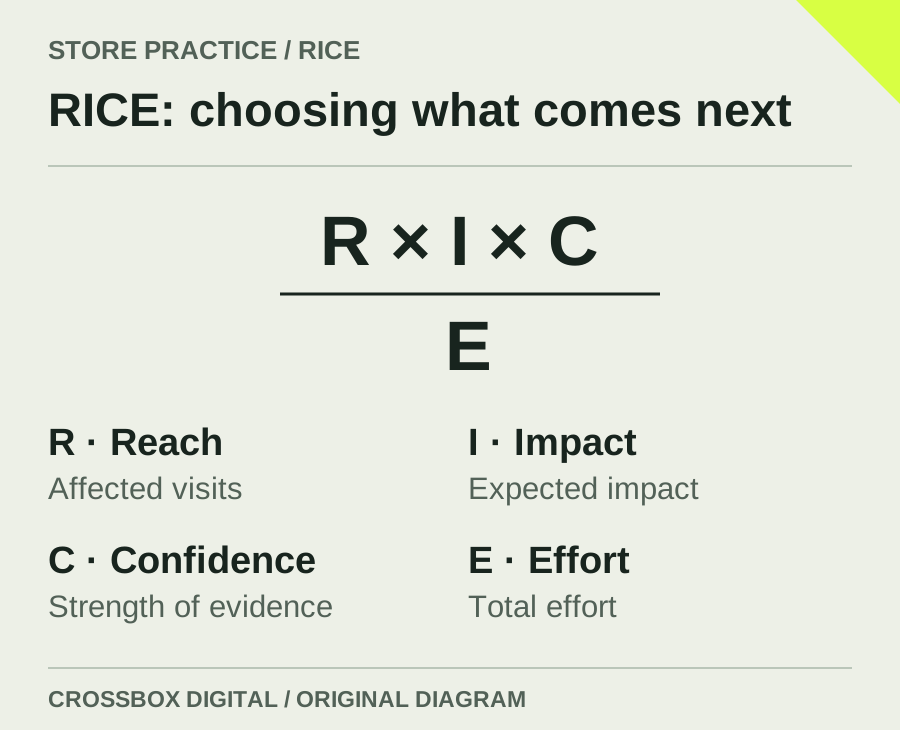
Intercom described RICE as a prioritization framework built around Reach, Impact, Confidence and Effort. The calculation is reach × impact × confidence ÷ effort. It compares possible projects under shared assumptions. The result is a relative priority score, not a revenue forecast. Intercom's original RICE explanation
Before assigning numbers, agree on the objective. Are you making the purchase journey easier to understand? Reducing avoidable service questions? Explaining a particular product group? Comparing ideas serving completely different objectives can become vague. For a first attempt, I would choose a limited set of related tasks and explicitly record the period being considered.
Describe a task someone can work on
“Improve the product page” is too broad to assess. A more specific task might present dimensions and selection guidance clearly beside the purchase area for one product group. Record the observed problem and proposed change. If the task cannot yet be described in a few sentences, an investigation may be needed first. That investigation can be planned as work in its own right.
Separate the observation from the suspected cause. Service may receive repeated sizing questions, but that doesn't automatically justify a new configurator. Missing information, unclear naming or unsuitable photographs could explain the difficulty. A precise starting point prevents a favorite, expensive solution from becoming the only option before prioritization has even begun.
Reach: Who actually encounters the problem?
For a Shopify purchase panel, I would base reach on the affected visits or people. Total store traffic is often too broad. A change to a rarely visited range reaches a different audience from a cart improvement. Use the same time unit for every idea and explain the counting method. Otherwise, numbers that appear comparable can describe different things.
Document incomplete data. A missing event shouldn't quietly be replaced with a conveniently large guess. Use a cautious range or improve measurement first. In a small store, comparing the affected pages may already help. The estimate needs to remain understandable so better information can replace it later without requiring the team to reconstruct how it was originally produced.
Impact: What changes for each affected person?
Impact concerns the expected importance of the change to the agreed goal. A visible selection problem may matter differently from another decorative animation. Explain the judgment through the task. What can someone currently not do, or do only with difficulty? What would change afterward? A high rating needs a reason beyond enthusiasm for the proposed feature.
Agree on a simple scale and apply it consistently. These values are working assumptions. An impact score of two doesn't mean conversion will double. When impact is uncertain, make that explicit and consider a smaller investigation. Perhaps revised information can be tested with suitable participants before commissioning a much larger feature. The next task may be learning enough to choose the implementation.
Confidence: How well supported are the estimates?
An idea can sound convincing while having little investigation behind it. Examine the evidence. Are there recurring service questions, observed difficulties and relevant usage data? Or does the proposal come from one internal opinion? That distinction helps when several projects look equally attractive. The quality of the evidence should affect how firmly the team commits to an estimate.
Confidence here is an assessment of the available basis. It isn't a statistical confidence level or proof that an effect will occur. Keep the evidence attached to the task and update the assessment when new information arrives. Sometimes a brief customer conversation or technical check is the most useful next project because it resolves a major uncertainty affecting several decisions.
Effort: Whose work is included?
Effort estimates often include development alone. A change may also require research, writing, translation, product maintenance, design and acceptance checks. Ask each participant about their contribution. Otherwise, an idea looks inexpensive because work outside development is invisible. Use a common unit. Estimated person-days may suit a small team better than months, provided every project is treated consistently.
Record dependencies too. A comparison feature might first require consistent product data. If nobody prepares it, the visible feature cannot be completed as expected. List those prerequisites where decision-makers will see them. Necessary preparation doesn't stop being work because another department owns it or because it hasn't yet received its own project entry.
A simplified calculation
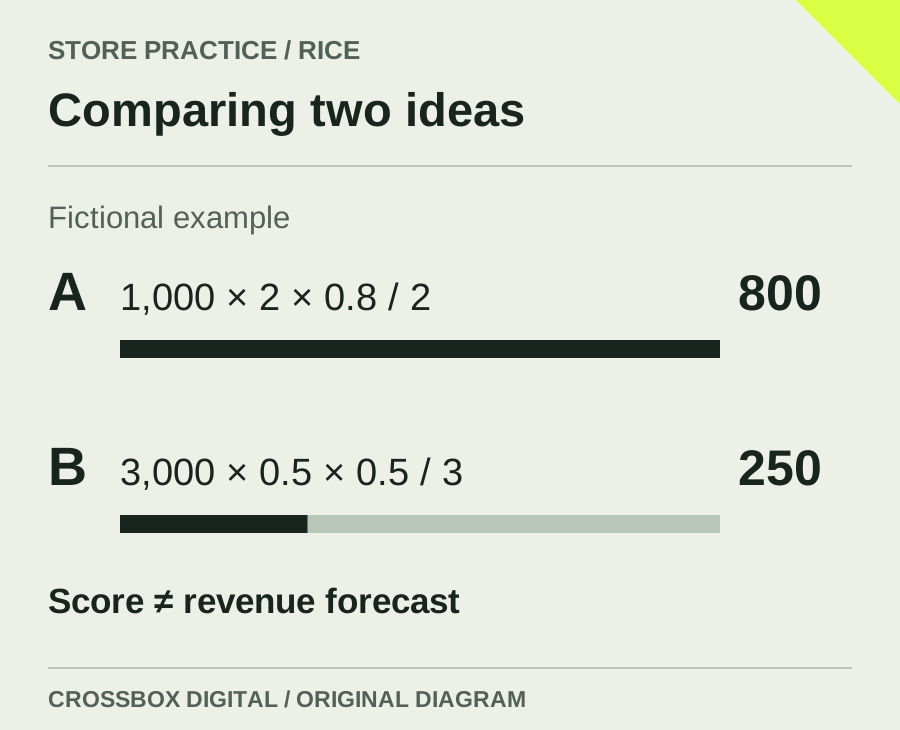
Consider two fictional projects covering the same month. Sizing guidance reaches an estimated 1,000 relevant visits. The team assigns impact of two, confidence of 80 percent and total effort of two person-days. The score is 1,000 × 2 × 0.8 ÷ 2 = 800. These invented numbers explain the calculation; they aren't taken from a client project.
A second idea reaches 3,000 visits, with impact of 0.5, confidence of 50 percent and effort of three person-days. That produces 3,000 × 0.5 × 0.5 ÷ 3 = 250. Under those assumptions, sizing guidance comes first. If its effort doubles, its score falls to 400. Calculations like these reveal which assumptions influence the order. The larger number doesn't prove a better commercial outcome.
Some tasks shouldn't wait for a high score
A blocked checkout doesn't need to compete against a marketing idea. Mandatory requirements, acute faults and necessary prerequisites need separate treatment. Identify them before scoring. Otherwise, an orderly ranking can produce a poor decision by comparing basic operational needs with optional improvements. The team remains responsible for deciding what the business needs now.
A strategic commitment may also justify departing from the order. A product group may need preparation for an already agreed introduction. Record the reason instead of altering the score until it produces the preferred answer. A documented exception is understandable. Numbers that change whenever someone challenges the result make the whole process less credible.
Turn the ranking into a limited assignment
Choose a small number of tasks and define acceptance. Who owns implementation? What information is still missing? Which observation will help show that the journey works better? A high RICE score doesn't answer those questions. Work becomes concrete when there is a manageable scope and a responsible person. The Shopify development brief helps translate an idea into an assignment that can be checked.
After implementation, add what was learned. Was effort estimated sensibly? Was the observed problem resolved? Which effect remains uncertain? These notes improve future decisions. MECLABS and Jobs to Be Done can help identify worthwhile questions. RICE then provides a way to discuss the order of the supported proposals.
Keep the record short enough to remain useful. An owner, the problem, the evidence behind the estimates and the next check are practical details. A large spreadsheet with unexplained scores can become another backlog nobody trusts. Someone joining the discussion later should be able to challenge an assumption without needing to recreate the whole conversation.
Common questions about RICE for CRO
Is RICE better than a simple effort-and-value list?
It makes additional assumptions visible, particularly the affected audience and the basis of the estimate. Whether that extra work is worthwhile depends on the decision. A simple list may be sufficient for a handful of obvious tasks. Use the amount of structure the discussion actually needs.
What if reliable numbers are missing?
Identify uncertainty and avoid invented precision. A reasoned range may be enough for a discussion. If a large commitment depends on an unknown quantity, investigate that missing information first. The score should help expose the gap rather than hide it behind a confident-looking total.
How often should scores be updated?
When new evidence, changed circumstances or completed work affect planning. A regular brief review may help. Recalculating every day without new information mainly creates work and makes the order unstable. Keep a record of why a rating changes when it does.
Have plenty of Shopify ideas but need a justified order? In a consultation, we can examine the available evidence, required effort and unresolved assumptions. Then we can decide which task your team can sensibly take on next, with a scope it can actually deliver.