
Jobs to Be Done for Shopify: What moves people toward a purchase
Two people buy the same backpack. One is starting a new job and wants to carry a laptop, lunch and sports clothing together. The other is preparing for a trip and needs a bag that's comfortable through several railway stations. The product is identical. Their circumstances, alternatives and unanswered questions differ. Jobs to Be Done directs attention toward those differences.
For a Shopify store, that perspective helps when product pages list plenty of attributes but say little about the purchase decision. You want to understand the situation that prompted the search and the progress someone hoped to make. That can produce better questions for product information, the offer and communication. The method doesn't hand you a finished advertising promise.
Look beyond a customer profile
The Christensen Institute describes Jobs to Be Done through the circumstances and forces behind decisions, including functional, social and emotional aspects. Someone is trying to make progress in a particular situation and considers different ways to do it. For store work, the journey leading to the purchase matters alongside the product itself. Jobs to Be Done at the Christensen Institute
A demographic characteristic rarely explains that journey on its own. Two people of the same age may expect different things from an item. Circumstances help identify relevant information. A commuter may look for a laptop compartment first. A traveler may care more about carrying comfort over time. These are illustrative possibilities that would need checking through actual customer conversations.
Discuss a purchase that really happened
For an interview, choose a recent decision. Ask the person to describe the sequence concretely. When did the need first become apparent? What were they using before? What happened before they began searching? The order of events helps distinguish an initial trigger from a later explanation. Hold back your suggestions so the person can describe their own recollection.
“Would you use our new configurator?” can easily produce a polite opinion. An actual story is more likely to reveal what someone attempted. Where did they search? What did they compare? Which alternative remained under consideration? You don't need to use specialist vocabulary in the interview. The participant should be able to describe their decision without learning your framework first.
Find the moment when the previous arrangement stopped fitting
The story often starts before the first store visit. An existing item no longer meets a new requirement. A gift is needed. A repair doesn't seem worthwhile. Ask about that moment and its circumstances. What changed? Which task became difficult with the previous solution? A specific memory may be more helpful than a broad statement about personal taste.
That understanding can support more precise marketing. You're describing a recognizable situation your offer genuinely addresses. It doesn't mean telling every visitor the same story. Several recurring situations may emerge. You can then examine whether separate entry pages would help or whether one product page can serve the relevant questions. The decision should follow the pattern rather than one memorable interview.
The alternative isn't always another product
Ask what the person could otherwise have done. They might have kept using the old item, borrowed something or postponed the purchase. Those alternatives change the value question. If the main hesitation concerns the effort of switching, another list of technical specifications may do little. An explanation of getting started or compatibility could matter more.
For household equipment, someone may want to know whether existing accessories remain usable. A business buyer may need to understand how ordering fits the company's process. These are possible research questions, not universal findings. Record which alternative was actually mentioned and which is your own assumption. That distinction prevents an appealing story from taking the place of evidence.
Record concerns alongside reasons to buy
Ask the person to recall the last uncertain moment before ordering. Which detail did they check again? Did they consult someone else? Was there a point where they nearly stopped? Such questions can reveal information that's missing or appears too late. They also help explain the difference between finding an offer attractive and choosing to act on it.
Keep notes close to the participant's wording where they've agreed to documentation. Include the context. A sentence taken out of its original situation shouldn't automatically become an advertising claim. Your working notes don't need unnecessary personal details. Collect what relates to the purchase task. Permission to publish a quote is a separate matter from permission to discuss the experience internally.
Organize conversations around recurring situations
After several conversations, compare the circumstances. Which starting points recur? Which alternatives are named? What concern appears repeatedly? A simple working overview is enough. Connect each interpretation with the underlying notes. Your team can then see whether a statement reflects several conversations or one person's recollection, and where further investigation might be needed.
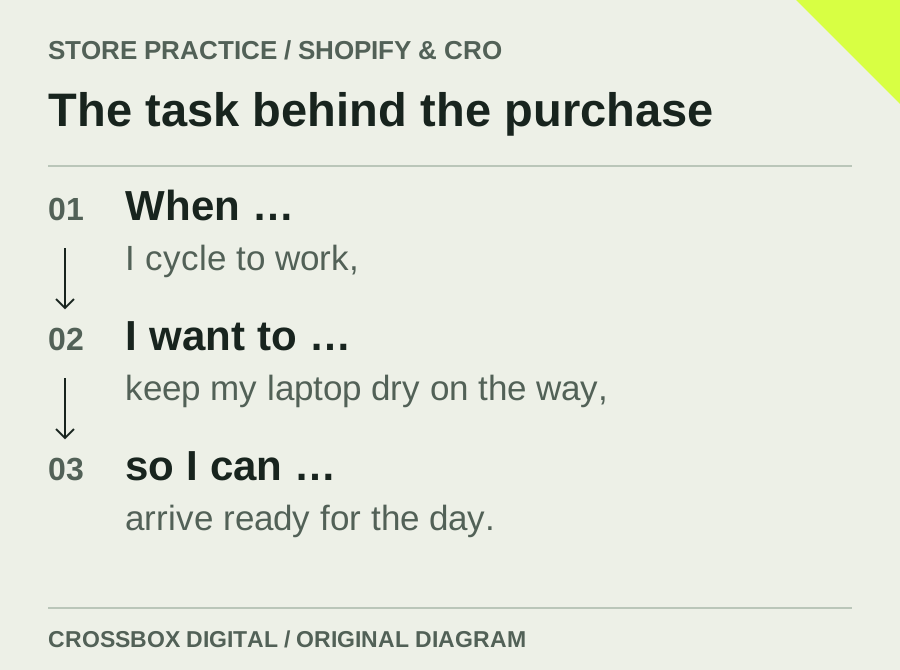
You can express a provisional job in a sentence: in a particular situation, someone wants to perform a task so they can achieve a desired outcome. Treat it as a working description. It doesn't need polished copy. If almost any product would fit, circumstances may be missing. If the sentence already prescribes a store feature, the solution may have entered the description too early.
Translate the finding into a particular page
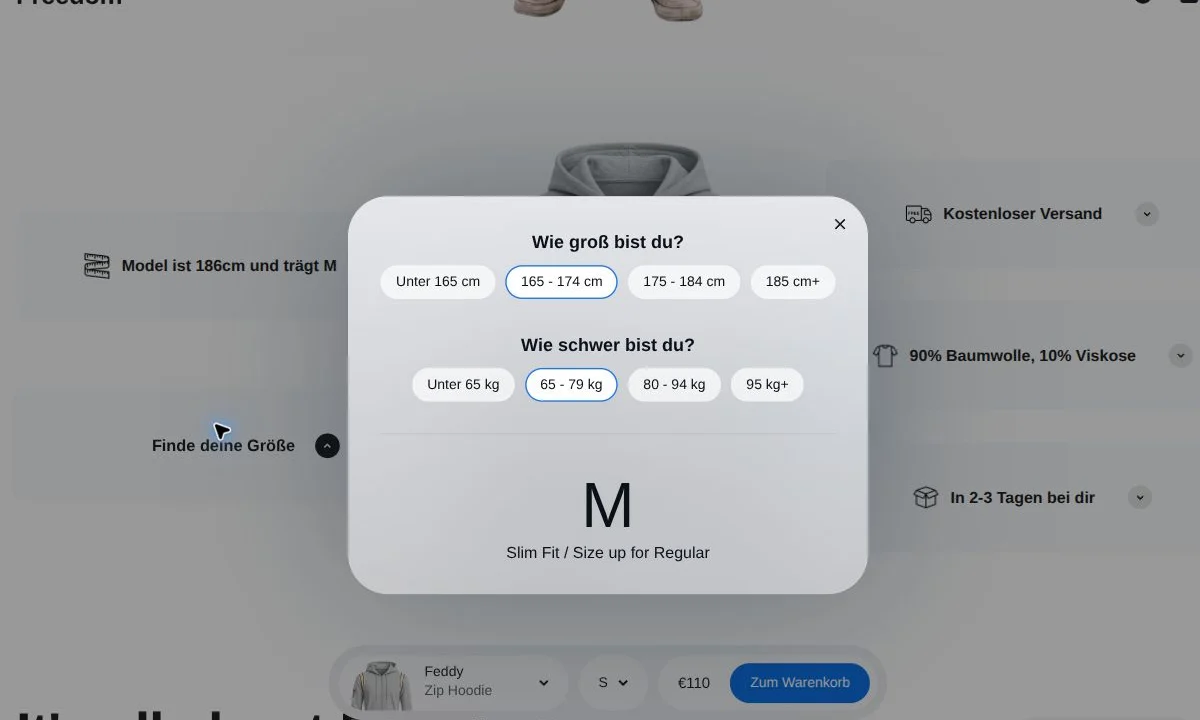
Return to the hypothetical backpack example. Suppose interviews indicated that people couldn't assess the usable compartment size. One response might be a photograph with understandable internal dimensions and clear limitations. That produces a change someone can examine. “Our customers want reassurance” would still be too vague to guide design or product maintenance.
Ask a suitable participant to attempt the task with the revised information. Can they work out whether their device fits? Do they understand which measurements to compare? If questions remain, revise the explanation. The MECLABS heuristic can help examine value and concerns systematically. The observed purchase situation should remain the basis for the work.
Use the insight before and after the store visit
The same finding may matter to an advertisement, a category page or a message after purchase. Keep promises consistent across the journey. If an advertisement describes a particular use, its destination should answer the associated questions. If a product needs an introduction, useful instructions after purchase may help. Every activity still needs a defined purpose and someone responsible for maintaining it.
For a small team, I would begin with one recurring situation and one product group. Larger ranges may involve several distinct situations. Before creating many landing pages, examine whether each would serve a different task. Additional pages are useful when their content has a purpose and can be maintained. Similar copy with different product names rarely makes the customer's decision clearer.
Don't confuse a useful explanation with proof of impact
An interview can support a persuasive hypothesis. It doesn't prove that a headline increases sales. Memories are incomplete, and a small group doesn't automatically represent every customer. Compare the findings with behavior, service questions and available usage data. Where an experiment can be planned appropriately, the effect of a particular change can be examined separately.
Qualitative findings remain useful with low traffic. You can improve an unclear explanation and observe the same task again. Describe the result as specifically as the evidence supports. CRO with low traffic provides a practical approach. When several ideas emerge, a shared prioritization process can help turn them into a realistic sequence of work.
Common questions about Jobs to Be Done
Does Jobs to Be Done replace my audience description?
It adds the situation and desired progress to your understanding. Existing customer data can still be useful. The important point is to avoid explaining the purchase decision entirely through age, location or other broad characteristics. People with similar profiles may be trying to accomplish very different things.
How many interviews do I need?
There isn't a universal number for this task. Begin with a focused research question and suitable participants. Examine whether patterns recur and which situations remain unexplored. A small interview round should not be described as statistically representative of the whole customer base.
Can I use existing reviews?
Reviews may contain clues about circumstances and concerns. They rarely include the complete decision story. Use them to develop questions and distinguish direct evidence from interpretation. Additional conversations can help recover the missing context before a particular review becomes the basis for a major change.
Want to understand which questions people bring to your store before buying? In a consultation, we can define a useful research question and a practical starting point. Then we can decide which product page or customer journey deserves closer examination first.