
Shopify migration with AI: Build faster, protect visibility carefully
A first version of a new store can appear quickly. AI assists with code, data preparation and repetitive tasks. That changes the migration conversation: if implementation can move faster, where does the difficult work remain? For a store heavily dependent on organic visitors, preserving established visibility is among the most important parts of the move.
I wouldn't attach a fixed loss to it. Saying that every migration inevitably costs a few ranking positions is too broad. Temporary fluctuations are possible. Their extent and duration depend on the actual changes and other influences. GEO introduces another distinction: an appearance in an AI answer isn't a universal ranked position. Useful planning needs precise terms and a baseline that can be checked.
Where AI can help with migration work
AI tools can assist with initial data comparisons, draft import rules and theme development. Shopify's AI Toolkit provides supported development tools with documentation, API schemas and code validation, among other capabilities. That supplies better context for platform work than an isolated prompt. It still doesn't confirm that an entire store has been migrated correctly. Shopify AI Toolkit
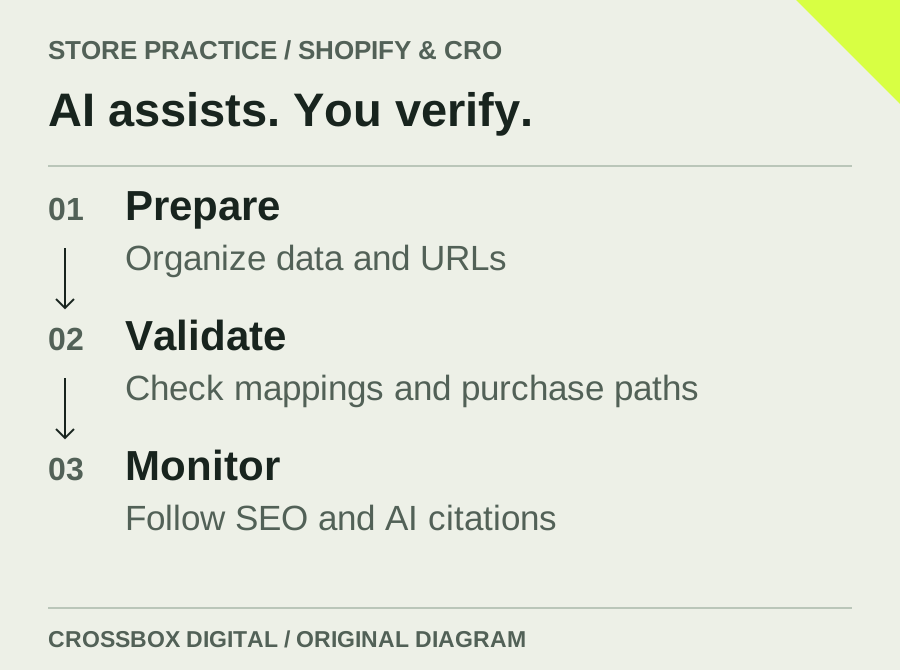
I would use that support for bounded tasks. A prepared list of unusual product records may be quicker to review than an unsorted export. The proposed interpretation still needs checking. Were variants understood correctly? Are languages associated properly? What happens when a value is missing? Faster preparation becomes useful when paired with a review that can catch the mistakes that matter.
Simplification starts with the business need
A migration is an opportunity to examine historical customizations. Some solved problems that now have different answers. Others remain important to the business. Associate each substantial feature with a task. Who uses it? How often? What would be missing if it disappeared? Then assess whether Shopify already provides a suitable option or whether additional development remains necessary.
AI can help organize the inventory. Decisions still need the team's operational knowledge. An export used rarely may be essential to a monthly process. A prominent feature may consume maintenance time while serving little current purpose. Simplification means removing unnecessary work while preserving important journeys in a manageable form. A smaller codebase alone doesn't demonstrate a better operation.
Established visibility cannot simply be regenerated
A new store can look finished before search systems have processed its pages again. Existing URLs, useful content and external references form part of the starting position. Changing categories, shortening text and replacing paths during the same move creates many simultaneous differences. Visibility therefore belongs in the discussion while the new structure is still being planned.
For a business dependent on organic traffic, that can become the commercial bottleneck. The interface is built, but important landing pages no longer serve their earlier purpose. That's a risk assessment for this type of store. Payments, stock information or integrations may be the greater concern elsewhere. Decide what needs protection first by examining the business model and its actual dependencies.
Losing a few positions isn't a fixed rule
Google describes possible temporary ranking fluctuations during site moves. It also says permanent redirects such as 301 don't cause PageRank loss. Neither statement guarantees stable rankings or establishes an unavoidable deduction of two or three positions. Search positions continue to be evaluated under the conditions of each search. Google on migrations and rankings
For planning, consider several scenarios without presenting one as a prediction. What would weaker visibility mean for important categories? Which campaigns or customer relationships could provide complementary demand? Who investigates a substantial decline? Those questions produce a practical response plan. Saying the loss will only be a few positions may offer reassurance while concealing a commercially important problem.
Record the starting point by page
Before moving, establish what each important page contributes. Review organic entry points, queries, relevant external references and commercial purpose. A URL list alone doesn't prioritize the work. Identify categories through which people find suitable products and content answering questions before purchase. Making those distinctions requires knowledge of the range and the people buying it.
Record the period and unusual circumstances. Seasons, promotions and assortment changes affect the figures. Preserve the baseline in a form the team can understand later. Keep language versions identifiable in multilingual stores. A management summary can remain short, but it should be backed by a list of actual destination pages and their planned treatment.
Check the mapping, not only the redirect count
An old product page should lead to an appropriate replacement where one exists. Categories need suitable destinations too. A large number of technically working redirects says little about whether people find the expected information. Review the most important mappings through actual examples. Someone familiar with a product family may recognize a poor match more readily than an automated comparison of names.
AI can prepare mapping suggestions. Uncertain cases need visible flags and an accountable decision. Examine content and internal references alongside URLs. If a new page has lost its useful explanation, a technically correct redirect doesn't solve the content problem. Shopify also documents redirect behavior and limitations that need to fit the planned implementation. Shopify URL redirects

Observe GEO separately
For AI answers, distinguish a brand mention, a linked citation and an actual visit. Those are different signals. Combining them into a single universal ranking position would obscure that difference. Bing, for example, reports cited pages and associated grounding queries. Its data describes the particular platform and the activity captured by that reporting system. Bing AI Performance
For a before-and-after review, record relevant questions and the sources observed in answers. Note language, market, system and date. One answer is a snapshot. Repeat the review under comparable conditions and retain the limitations of each tool. If a previously cited page changes, its informational role belongs in the migration review. That still cannot guarantee that a particular citation will remain.
The foundations still matter for AI search
Google continues to describe familiar SEO principles for its AI search features. Important information should be accessible and understandable, internal links aid discovery, and structured data should match visible content. Special AI markup isn't required. Inclusion remains a decision made by the search system. Google on AI features and websites
For the project, I would first preserve the pages carrying important information and check their accessibility. A new filename or additional machine-readable list doesn't replace that work. Keep product knowledge, examples and responsibilities understandable in the new store. Replacing every specific explanation with interchangeable AI copy may simplify the visible interface while weakening the information people came to find.
Treat the period after launch as project work
After publication, give someone clear responsibility for monitoring and corrections. Review important destination pages, real purchase journeys and the available search data. Investigate a decline instead of reflexively treating it as a normal migration effect. A good first day doesn't prove that processing has finished either. Separate technical findings, changes in demand and individual page performance as far as the evidence permits.
Use time saved by AI for this preparation and review. A suitable partner should identify unresolved risks and plan their investigation. The article on choosing a migration partner helps prepare that discussion. The migration checklist and development brief provide practical ways to describe the work and agree how it will be checked.
Keep that distinction in the proposal. Ask which activities AI supports, how the outputs are reviewed and who owns corrections. The answer should describe a working process you can inspect. A general promise that everything is now easier doesn't tell you whether the particular pages and workflows your business depends on will receive the attention they need.
Common questions about AI, migration and rankings
Does every store lose rankings during migration?
No. A universal or measurable loss isn't inevitable. Fluctuations can occur, and their extent depends on the project and other influences. A fixed predicted loss would be as unreliable as a guarantee that every position remains unchanged throughout the move and afterward.
Can AI handle an SEO migration completely?
It can assist with bounded tasks such as comparisons and suggestions. Appropriate mapping, technical validation and decisions about important content remain necessary. Review generated work before implementation and check it afterward. Speed doesn't establish that a proposed destination or content change is correct.
How long should performance be monitored?
That depends partly on the scope of the move and processing by search systems. Agree a supported period with regular checks and named responsibilities. A particular calendar date doesn't guarantee complete indexing or stable positions. The observation plan should reflect the actual changes and findings.
Planning a Shopify migration and want to reduce work sensibly with AI? In a consultation, we can examine the starting point, possible simplifications and the pages whose visibility matters most to your business. That gives us a basis for an appropriate implementation and review plan.