
Choosing the right partner for your Shopify migration
You've decided to move your store to Shopify. Three proposals arrive. One focuses on design and templates. Another contains a long list of technical services. The third promises a particularly fast launch. The prices differ considerably, yet you still don't know who understands the work that keeps your business running. Choosing a migration partner starts with that question.
I pay attention to the questions asked before the proposal is written. Which orders must remain accessible? Where does product information originate? Which pages attract organic visitors? Who uses the store every day? Those answers determine the actual scope. Here's a way to assess conversations and proposals without needing to understand every technical detail yourself.
Explain why the move matters
“We want Shopify” names the destination. It doesn't explain the business reason. Perhaps every small change takes too long. Perhaps your team corrects stock manually across several systems. Or the existing purchase journey no longer suits your range. Write down the actual situations. An example from yesterday's work is more useful than a list of wishes such as modern, fast or flexible.
Include the people who will work with the result. Customer service knows the problems with older orders. The warehouse knows which information is missing during dispatch. Marketing can identify the pages supporting current campaigns. These conversations produce a short list of tasks that must work after the move. Use that list when assessing a supplier's proposal.
Follow a real order through the business
A useful opening question involves an ordinary order with a small complication. Someone buys two variants, uses a voucher and later returns one item. Ask the potential partner to describe that journey across your existing systems. Where does stock information come from? What reaches the warehouse? Where will service handle a question? Which details does your accounting system need?
Nobody has to know every answer immediately. Watch how uncertainty is handled. Are assumptions identified? Does someone ask about the integration provider? Is there a suggestion to test the difficult part before committing to a plan? An unchecked promise only moves the problem into a later phase. A specific investigation makes the missing information visible.
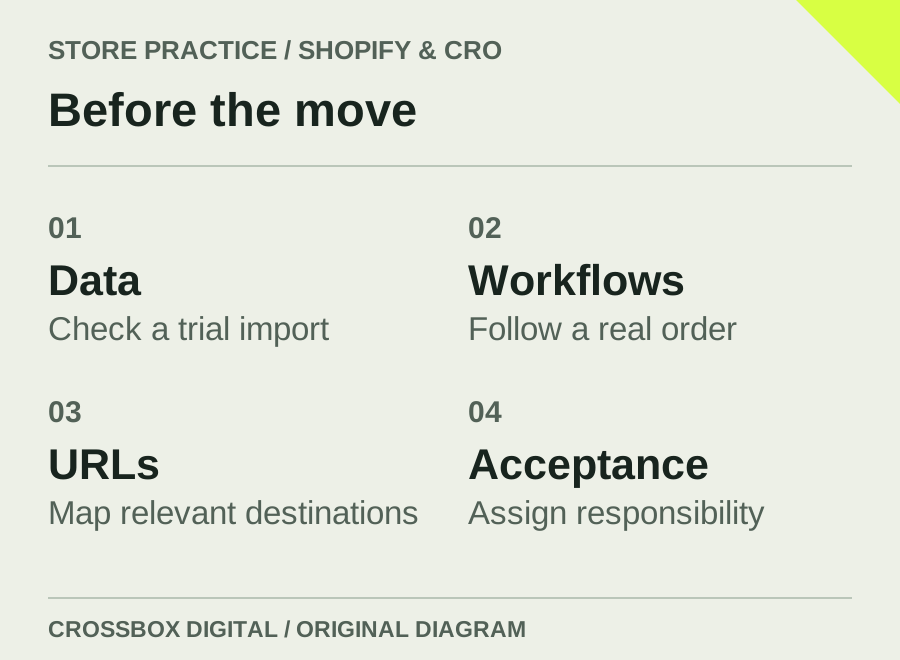
Discuss a trial migration
“Import products, customers and orders” rarely describes enough. A product may include variants, translations, downloads and custom fields. Orders have different statuses and relationships. Shopify describes several transfer methods depending on the data involved. The appropriate route for your store should be checked against actual examples. Shopify's migration overview
Include difficult records in the trial. Choose a product with many variants, a customer with several orders and an item carrying unusual information. Ask to see what arrived in the destination system. Matching record counts doesn't prove that everything is correctly associated. Agree who approves the business details and how corrections will be handled before the full import runs.
Give SEO a named owner
Redirecting old URLs is a practical project task. It requires an inventory and a decision about which new page appropriately replaces each old one. Ask for an example from your store. A category attracting useful visitors deserves different attention from an abandoned campaign page. Who decides which cases matter most, and who implements the mapping?
SEO work should appear in the schedule before launch. If the responsible person only sees the finished store, some decisions become expensive to reverse. Ask how old and new pages will be compared and what will be monitored afterward. Google's migration guidance describes possible temporary ranking fluctuations. A supplier cannot reliably guarantee a fixed search position. Google's site move guidance
Compare the same work across proposals
A price comparison becomes useful when suppliers describe equivalent deliverables. Prepare a short list of tasks and their expected results. For data, that might mean a checked import with documented exceptions. For the theme, specify the required page types and variations. For integrations, name the affected business processes. Ask what vague terms such as “standard integration” mean for your operation.
Separate implementation costs from ongoing expenses. Licenses, external services and later support may all matter. Keep unresolved assumptions beside the price. If a proposal excludes data cleanup, that's a concrete boundary you can discuss. You can then decide who will do the work. The article on migration costs explains how scope makes a price comparison possible.
Choose a working arrangement that fits
An agency may provide several specialist roles within one team. A freelancer can offer a close working relationship and direct communication. Either arrangement can suit a project. Ask about the people who will actually do the work. A large team on a website tells you little about who checks your import or remains available during the domain switch.
For a larger project, clarify cover and escalation. Who decides what happens if a serious problem appears shortly before launch? Who can make a technical correction when the main contact is unavailable? A smaller store may work well with a lean arrangement, provided its limits are understood. Necessary tasks need owners, particularly where several companies share responsibility.
Look for relevant experience in references
A reference is especially useful when its starting conditions resemble yours. Ask what the supplier actually delivered. Did they manage the data move, develop the theme or design individual pages? Which difficult decision did the team face? What needed correcting afterward? An honest account of that work tells you more than familiar logos without an explanation.
The IDEAL project, for example, involved bringing two previous websites together on Shopify. Its description explains why the trial migration, customers, orders and redirects needed to be considered together. Those details help you assess relevance. Another store's commercial results remain its own results. Demand, product range and ongoing marketing all affect what happens after a migration.

Agree on acceptance before time gets tight
Both sides should know what counts as finished before implementation begins. Write practical scenarios for the purchase journey: select the right variant, change quantity, use a voucher and find the resulting order in the destination system. Include internal tasks such as product maintenance and service questions. The list should reflect your business. Recreating every historical customization isn't necessarily useful.
Agree how unresolved issues will be treated. Some should block launch. Others may have an acceptable temporary workaround. Someone needs responsibility for that decision. Avoid inventing the rules while a campaign is already running. A workable schedule includes checking and correction time, along with an agreed approach to records created while the store is being moved.
Include the first weeks after launch
The domain switch begins a period when real orders and real questions reveal how the store behaves. Clarify the length and scope of support. A technical contact isn't enough if nobody owns a missing order association. Record how issues are reported, who assesses them and what response is expected when customers cannot complete a purchase.
Before choosing, bring the comparison into one short overview: understood scope, unresolved risks, named people and verifiable deliverables. A higher price can then be assessed properly. It may include necessary work missing elsewhere. Or it may include work you don't need. Both are easier to discuss once the differences are concrete. The migration checklist can help you prepare.
The same overview is useful inside your own company. Someone who wasn't present during the supplier meetings should be able to see what has been agreed. That helps prevent a later misunderstanding about responsibility or timing. Keep the document short enough that people actually use it, and update any assumption that changes before work starts.
Common questions about choosing a partner
Must my partner have migrated exactly the same platform before?
Relevant experience helps. What matters is whether your store's data structures, integrations and unusual cases are understood and checked. Ask for a practical test plan. A similar reference doesn't replace a trial migration involving your own requirements and records.
Is a fixed price appropriate for a Shopify migration?
A fixed price works better when scope and assumptions are understood. Uncertain data quality or untested integrations make reliable estimates harder. An initial assessment can help both parties agree the implementation scope more accurately before making a commitment.
When should I arrange the first consultation?
Once the reason for moving is clear, and before communicating a firm launch date. Bring the existing store, the main connected systems and a few actual problems. You don't need a completed technical specification to start a useful conversation about the project.
Want to understand which support your migration needs? In a consultation, we can look at your existing store, the important workflows and the unanswered questions. That gives us a practical starting point for deciding what your project needs next.